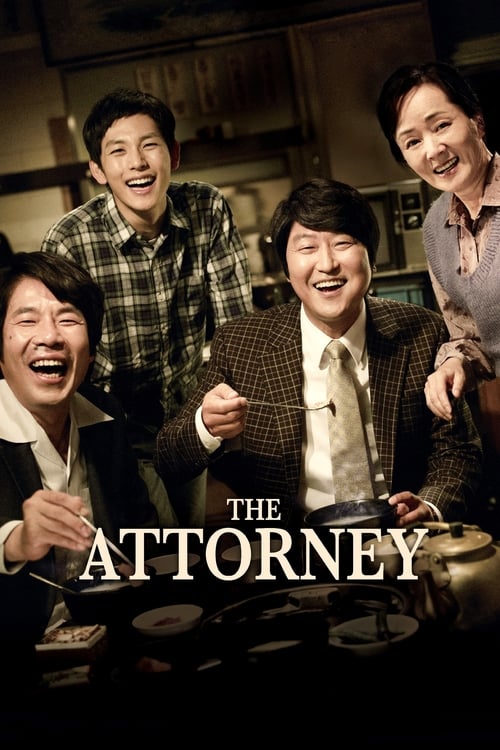
The Attorney (2013)
The Moment an Ordinary Materialist Stood Before His Conscience
by 10days1movie · Published 2026-10-21
| Type | Movie |
|---|---|
| Director | Yang Woo-suk |
| Cast | Song Kang-ho, Kim Young-ae, Oh Dal-su, Im Si-wan, Kwak Do-won, Cho Min-ki |
| Release | 2013 |
| Genre | Drama, History |
| Runtime | 127min |
When Song Woo-seok first appears, he is by no means a hero. He is a lawyer who rakes in money through lucrative real-estate registrations and tax work, in some ways close to a materialist. The Attorney’s power lies in exactly this starting point. Rather than a grand idealist, it shows a thoroughly pragmatic man becoming, little by little, a different person before a case he simply cannot turn away from.
What it’s about — The torture of a gukbap-shop’s son shakes a comfortable life
In early-1980s Busan, the high-school-educated lawyer Song Woo-seok (Song Kang-ho) has established himself as a specialist in tax and registration work and enjoys a fairly affluent life. Jin-woo (Im Si-wan), the son of the gukbap shop he frequents, is a diligent young man preparing for the bar exam. Then one day Jin-woo is dragged off without a warrant for taking part in a study group reading “seditious” books, tortured, and made to stand trial on absurd charges. Before the desperate plea of the gukbap-shop mother, Song Woo-seok decides to take on the defense of a political case he had never once set foot in. This choice shakes the whole of his once-comfortable life.

Direction — From a materialist’s lightness to the heat of advocacy
Director Yang Woo-suk, despite this being his debut, places the story’s center of gravity precisely. The first half lightly sketches Song Woo-seok’s sly materialism in a way that makes the audience laugh, and because of that lightness the weighty turn of the second half carries a greater resonance. So that you can clearly see where a man starts and where he arrives, the director builds the emotional curve up steadily without rushing.
The direction of the courtroom scenes is the film’s highlight. The passage of putting a torturer-officer on the witness stand and driving him into a corner, and the second-half argument reciting Article 1 of the Constitution, are direct and impassioned. The method of raising emotion somewhat high may feel burdensome, but because the intent to share with the audience the anger of an event based on a true story is clear, it does not lose its persuasiveness. The art design recreating the air of the era and the restrained use of music also support the film’s sincerity.
What the director never lets go of to the end is the consistency of the character. The courage Song Woo-seok shows in the second half is not a sudden awakening but something that grows naturally from the personality laid down in the first half. That nature of cherishing his family fiercely, keeping a promise once made, and ultimately being unable to endure injustice simply erupts when it meets a political case. So his transformation does not feel contrived; rather it arrives as something that could happen to anyone.
Performance — Song Kang-ho holding materialism and conscience in one breath
It is no exaggeration to say Song Kang-ho’s performance is nearly the whole of this film. He moves naturally, in a single breath, between the almost vulgarly honest materialism of the character Song Woo-seok and the human conscience hidden within him. Even in the courtroom scenes where his voice cracks with rage, his acting does not drift into exaggeration but honestly conveys the trembling of one ordinary man discovering his convictions. Im Si-wan, playing the tortured young man Jin-woo, holds fear and injustice in a restrained gaze and leaves a strong impression, and Kim Young-ae, as the gukbap-shop mother, holds up the film’s whole sentiment with a short role. The chill of the torturer-officer played by Kwak Do-won, too, tightens the drama’s tension firmly.

What the film says — The first sentence that the nation belongs to its people
The message The Attorney offers is condensed, just as the line in the film says, in the Constitution’s first sentence that the nation belongs to its people. But the point the film digs deeper into is how much courage upholding that obvious principle demands of one individual. The film treats seriously, to the end, the weight of the choice by which a man with much to lose stakes all of it for what is right. The way it illuminates an era not through grand history but through one person’s conscience is what makes this work endure.
Ratings & reception
By the major film database, the rating is 7.7 out of 10, high even among Korean films. The critical freshness metric recorded 77 percent. Drawing more than 11 million viewers, it seized box office and acclaim at once, and is steadily cited as one of Song Kang-ho’s representative works.

Verdict
The Attorney is impassioned yet not flimsy. Through one character’s transformation it conveys a weighty theme persuasively and confirms anew the true worth of the actor Song Kang-ho. The somewhat direct emotional appeals may give pause, but the concentration of that sincerity leaves no room for doubt. On that count, ★4.0 is an honest assessment.
Recommended for
- Those who love dramas that deeply follow one character’s growth and change
- Those who want to feel the full strength of Song Kang-ho’s acting
- Those drawn to a weighty courtroom story based on a true event
Comments