
Haeundae (2009)
The Starting Line of the Korean Disaster Blockbuster
by 10days1movie · Published 2026-09-23
| Type | Movie |
|---|---|
| Director | JK Youn |
| Cast | Sol Kyung-gu, Ha Ji-won, Park Joong-hoon, Uhm Jung-hwa, Lee Min-ki, Kang Ye-won |
| Release | 2009 |
| Genre | Action, Drama, Thriller |
| Runtime | 129min |
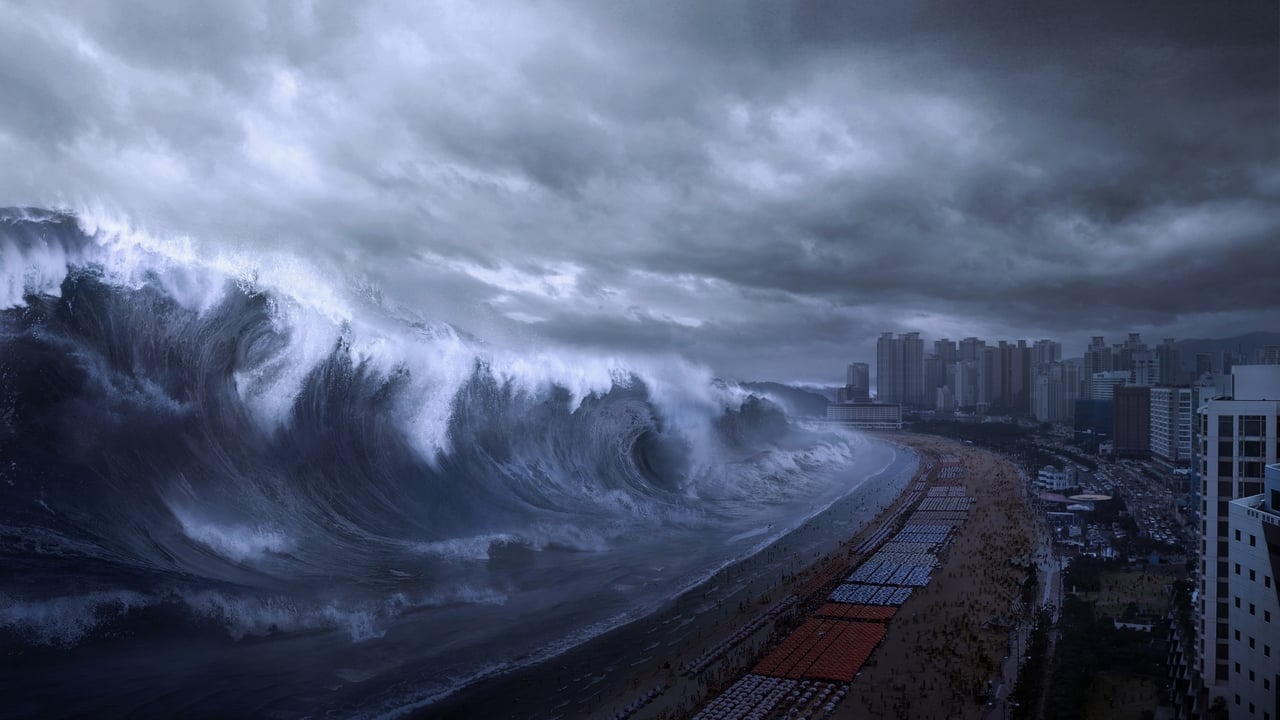
What if a colossal tsunami struck Busan’s Haeundae Beach during the height of summer vacation? Haeundae is a film that begins from that single line of imagination. It was an attempt to build a disaster blockbuster, a genre Hollywood had all but monopolized, atop a real Korean place name, and in 2009 it was a considerable gamble. As it turned out, the film drew over ten million admissions and proved, for the first time, the possibility of a Korean disaster movie as a genre.
What it’s about — Everyday life on a Busan beach and a megatsunami
The film divides broadly into two parts. The first half is the everyday life of ordinary people living in Haeundae. A fisherman named Man-sik, who carries the trauma of losing a colleague in the Indian Ocean tsunami, the woman Yeon-hee whom he loves, the geologist Kim Hwi and his ex-wife Yu-jin, and various figures around them all appear, each carrying their own story. The latter half is the assault of a massive tsunami that swallows that everyday life in an instant. Hwi warns that there are signs of a megatsunami in the East Sea, but he is not heeded, and at last a giant wall of water descends upon Busan.
Direction — Disaster striking characters you’ve grown fond of
Director JK Youn’s strategy is clear. The first half uses comedy and romance to make us grow fond of the characters, and the second half drives ahead with full-scale disaster spectacle. Thanks to this structure, the moment the tsunami strikes, the audience receives it not as mere spectacle but as a situation in which people we know are in danger. Once you endure the somewhat loose comedy of the first half, the urgency of the second half lands all the harder.
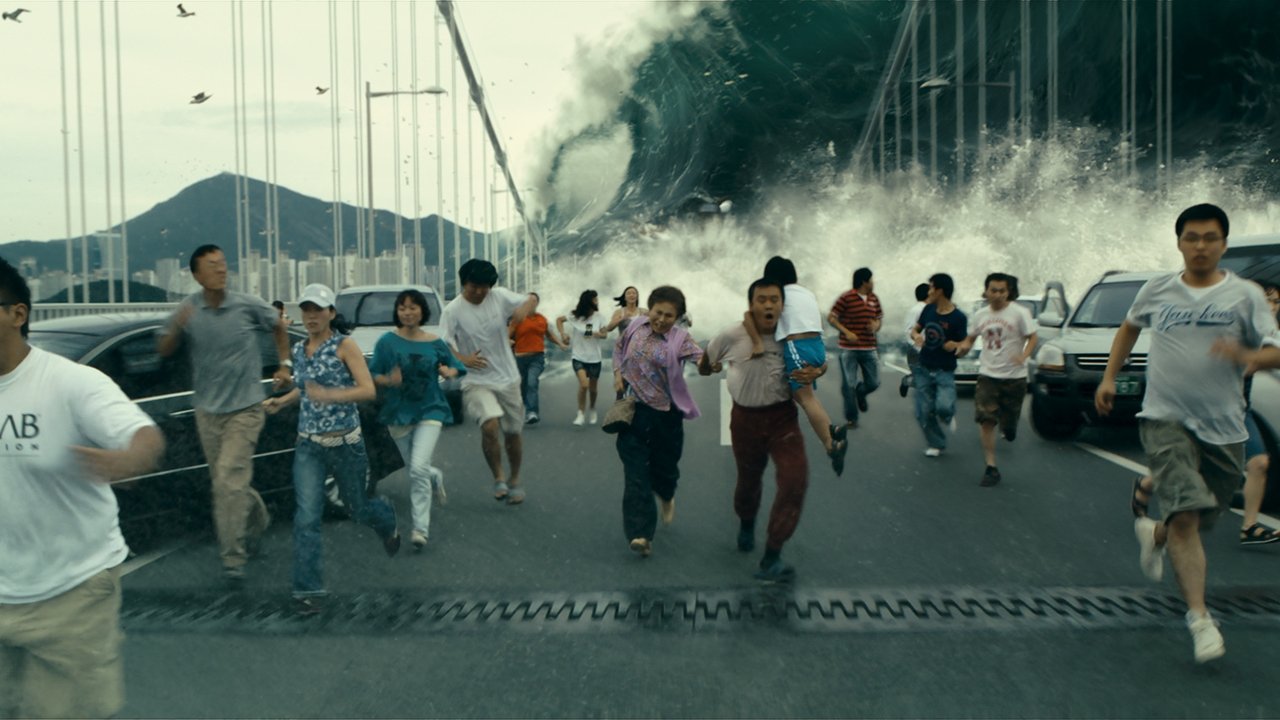
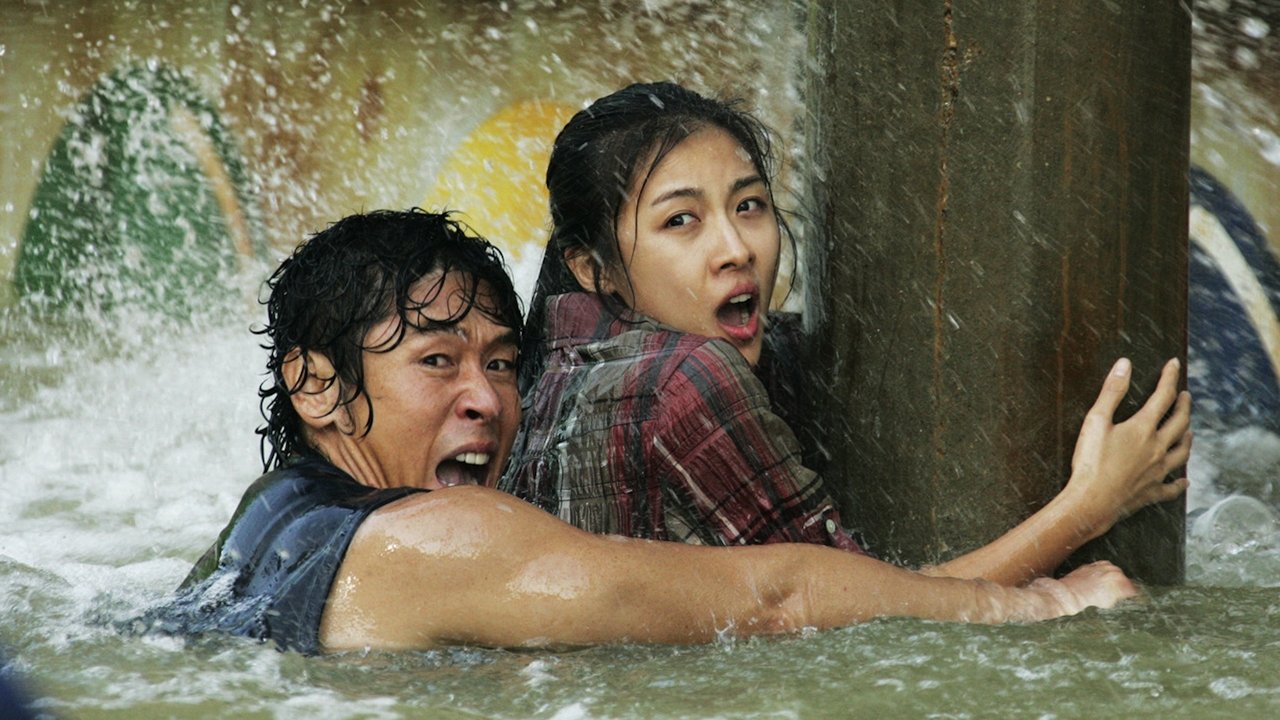
The visual effects, ambitious for a Korean film at the time, are also worth noting. The waves engulfing the Gwangan Bridge, the crowds fleeing the packed beach, the muddy water surging into the city center, while hardly perfect, generate a sufficiently menacing scale. The skill of drawing out a sense of disaster’s magnitude within limited technology and budget is a clear achievement. The disaster sequences in the latter half do not merely show a big wave; they interweave the crises each character faces, ratcheting up the tension. Someone is trapped in a collapsing building, someone risks their life to save family swept away by the current. The editing that follows these multiple struggles at once faithfully observes the basic grammar of the disaster film while dissolving a distinctly Korean sentiment into it.
Performance — Sol Kyung-gu and Ha Ji-won filling out the emotion
The actors’ performances are the sturdiest pillar holding up this film. Sol Kyung-gu wryly renders Man-sik, a rough but warm-hearted fisherman, taking charge of the first half’s laughter, while Ha Ji-won plays the spirited, resourceful Yeon-hee at his side with vitality. Park Joong-hoon expresses the helplessness of a scholar who foresees the disaster yet cannot prevent it, and Uhm Jung-hwa stably portrays the complexity of a woman torn between family and career. With so many characters, it is a shame that some stories cannot deepen enough, but the actors’ individuality fills much of that gap.
What the film says — The choices of people facing disaster
Haeundae’s true theme is not disaster itself but the choices of people facing disaster. Someone risks their life for family, someone tries to fulfill their duty to the end. The sacrifice and love that ordinary people show in extreme circumstances are precisely what the film labors most to depict. So the work begins with the spectacle of dazzling destruction yet closes with the warm question of what makes a human being human. At the same time the film reminds us how small a being humanity is before nature. Ignoring the voices that warn in advance and floundering only once disaster strikes is not merely a dramatic device. This passage, which evokes the importance of prediction and preparation, shows that a disaster film can become a mirror reflecting reality beyond entertainment.
Ratings and reception
Haeundae holds a 5.5/10 on IMDb, not especially high. A somewhat formulaic family drama and a latter half close to melodrama appear to have divided opinion. Domestically, however, it surpassed ten million admissions for a major box-office success, and its significance in proving that Korean cinema could attempt a full-scale disaster blockbuster is unmistakable. As the starting point for the many Korean disaster films that followed, it is a work of no small industrial significance.
Verdict
Haeundae is a film with visible gaps in its craft. It is scattered with too many characters, and its way of drawing out emotion is somewhat direct. Even so, the affection carefully built up for the characters in the first half works powerfully in the disaster of the second. Recalling its challenging spirit, which tried to push past the limits of the genre, and the actors’ fine work, I personally find myself sending it the goodwill of four stars.
Recommended for
- Those who love disaster films blending spectacle with family drama
- Those who want to see firsthand the starting point of the Korean blockbuster
- Those who want to enjoy familiar actors’ chemistry and the stage of Busan
Comments