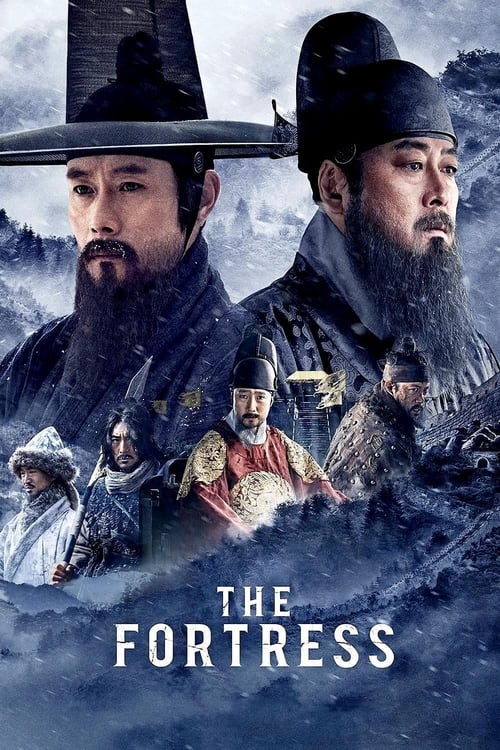
The Fortress (2017)
Between Principle and Survival, a Record of 47 Brutal Days
by 10days1movie · Published 2026-10-23
| Type | Movie |
|---|---|
| Director | Hwang Dong-hyuk |
| Cast | Lee Byung-hun, Kim Yoon-seok, Park Hae-il, Go Soo, Park Hee-soon, Song Yeong-chang |
| Release | 2017 |
| Genre | War, Drama, History, Action |
| Runtime | 140min |
Say “war film” and people usually picture vast battles and heroic feats. But The Fortress has no rousing victory, no satisfying counterattack. What this film depicts is 47 days of collapse, trapped in cold and starvation. Director Hwang Dong-hyuk does not dress up the disgraceful history of the Qing invasion of 1636 in finery; instead he unfolds, with gravity, the war of words waged within it. Even while handling a history whose outcome we already know, the film keeps your palms sweating to the end.
What it’s about — Hardliners and peace-seekers trapped in an isolated fortress
In the winter of 1636, a great Qing army invades Joseon. King Injo (Park Hae-il) and his court ministers, unable to escape to Ganghwa Island in time, take refuge in Namhansanseong. Inside the isolated fortress the food runs out and the cold cuts to the bone, while the court splits into two camps. Kim Sang-heon (Kim Yoon-seok) of the hardliners insists they must fight to the end to uphold their cause, while Choi Myung-gil (Lee Byung-hun) of the peace-seekers argues they must endure humiliation and seek terms to save the people. Amid the sharp clash of the two ministers, Injo wavers, unable to make a decision, and the people and soldiers inside the fortress die day by day.

Direction — A swordfight waged with words, not blades
Hwang Dong-hyuk’s direction shows an aesthetic of restraint and condensation. The film’s stage is mostly confined to the cramped fortress, and there are few large battle scenes. Instead he fills the screen with the physical agony of cold and starvation. As details like snow-covered ramparts, frozen hands, and a council chamber where breath fogs the air accumulate, the audience sinks into the sensation of enduring that brutal winter alongside them.
This film’s true battlefield is not swords and arrows but words and principle. Hwang stages the debate between Kim Sang-heon and Choi Myung-gil as tautly as a duel. Both men’s arguments carry their own logic and sincerity, so the audience cannot easily take a side. The music by Ryuichi Sakamoto supports that tension with restrained melodies, casting a solemn sentiment over the whole film.
Performance — A clash of convictions between Lee Byung-hun and Kim Yoon-seok
The face-off between the two actors Lee Byung-hun and Kim Yoon-seok is this film’s greatest spectacle. The Choi Myung-gil played by Lee Byung-hun is a realist who endures humiliation to save the people, and his calm yet solid performance persuasively conveys the character’s anguish. The Kim Sang-heon played by Kim Yoon-seok is an upright figure who tries to uphold cause and principle to the end, rendering the weight of that conviction with a heavy presence. The scenes in which the two argue in court generate a tension tauter than any action.
Park Hae-il, playing the irresolute monarch Injo, delicately shows the helplessness of a man who, though at the apex of power, can decide nothing. Go Soo, playing the blacksmith Nal-soe, stands in for the gaze of the common people who simply live on, untouched by power struggles, adding another grain to the film.

What the film says — The heartlessness of history that tramples even sincerity
The Fortress asks what a human being should choose between the hardly reconcilable values of principle and survival. Is it right to uphold one’s cause at the risk of death, or to endure disgrace and survive to plan for the next day? The film declares neither side the answer. Kim Sang-heon and Choi Myung-gil merely walked opposite roads; both shared the same heart for Joseon and its people. What the film renders is the heartlessness of a history in which those sincerities are, in the end, helplessly trampled.
Ratings & reception
By OMDb, the IMDb rating is 6.8. The Rotten Tomatoes freshness score is recorded at 63%. Domestically the acting duel of the two leads and the weighty thematic awareness drew high marks, but the development flowing around debate without large battles or dramatic twists felt somewhat static to some viewers. Even so, the stance of honestly gazing at the suffering and conflict rather than glorifying history earned broad support.

Verdict
The Fortress is a film that leaves deep contemplation in place of catharsis. Even while handling a history whose ending is already known, it sustains tension to the end through the anguish of the humans within it. The two actors’ performances, the restrained direction, and a question not easily answered come together to leave a weighty resonance. If you expected a flashy war film it may be somewhat unexpected, but to those who know the value of that gravity, four stars are by no means a waste.
Recommended for
- Those who love period dramas focused on characters’ conflict and debate over action
- Those who want to see the acting duel of Lee Byung-hun and Kim Yoon-seok
- Those drawn to works that handle history honestly rather than glorifying it
Comments